What I Do While the Agent Works
On this page 12 sections
A month ago I wrote I Don’t Need AI for That. One line from it kept bothering me after I published it:
Instead, the agent writes the code while I open TikTok.
I still use AI agents every day, and I don't plan to stop. They help me with code, documentation, and hardware I'm still learning. But the waiting kept happening. I send a prompt, and Claude works for thirty seconds, or two minutes, or five. I check the result, send the next prompt, and wait again.
None of these waits feels like much. I wanted to know what they add up to.
I measured the waiting#
Claude Code saves a transcript of each session on my laptop for 30 days, with a timestamp on every message. I wrote a small script that goes through two weeks of those logs, from 12 to 25 October, and measures how long each prompt took: from the moment I sent it until Claude's last message before my next one.
There were 1,056 prompts in those two weeks.
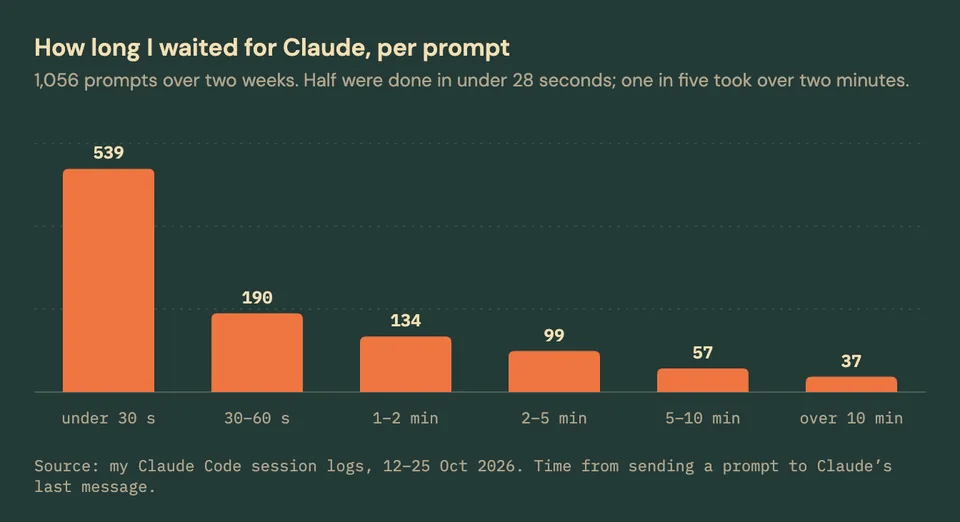
Half of them were done in under 28 seconds. Those are the quick questions and small edits. About one in five took more than two minutes: the larger changes, where Claude reads several files, edits them, and runs the tests.
Then I added the waits up for each day.
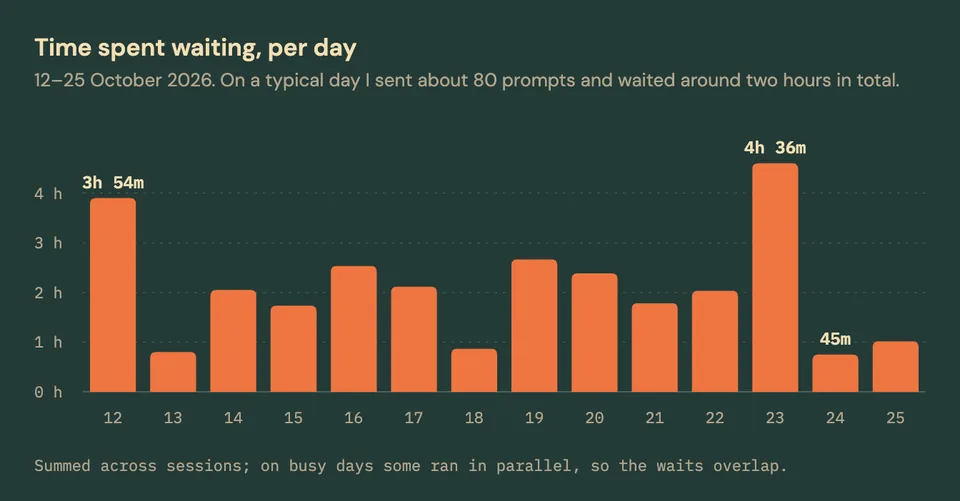
On a typical day I sent about 80 prompts and waited around two hours in total. That number is a little generous: on busy days I had more than one session running, so some of the waits overlap. Even so, it was more than I expected. Two hours is a long time to spend not quite working and not quite resting.
Most weekend days were quieter, which is a good sign for my weekends. The peaks were days when I was building something bigger and let Claude take longer steps.
The gaps are too short to decide anything#
I tried telling myself to use the time better. It didn't work, and I think I understand why now.
A wait of thirty seconds is too short to decide anything. By the time I've thought "what useful thing could I do right now?", Claude is done. Scrolling wins because it needs no decision at all. The phone is already in my hand, and the feed is already full.
The longer waits have a different problem. If Claude takes five minutes, I can drift a long way in five minutes. Coming back from a feed is harder than coming back from a pause. I have to remember what I asked, read the result, and get back into the problem. The wait didn't cost me much, but the scrolling did.
So I didn't want another app or another good intention. I wanted something with a few specific properties:
- It starts by itself when the wait starts, so there is nothing to decide.
- It fits in seconds, so a 28-second wait is enough.
- I can leave at any moment without losing anything, because Claude decides when the wait ends, not me.
- It's worth something afterwards, unlike the feed.
- It stays on my machine, with no account and nobody counting my habits.
Flashcards fit almost all of that already. They just needed to show up at the right moment.
A flashcard instead of the phone#
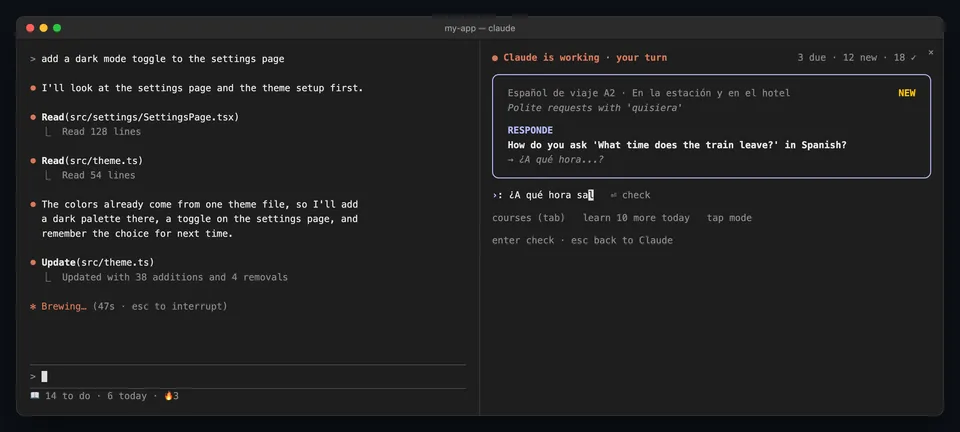
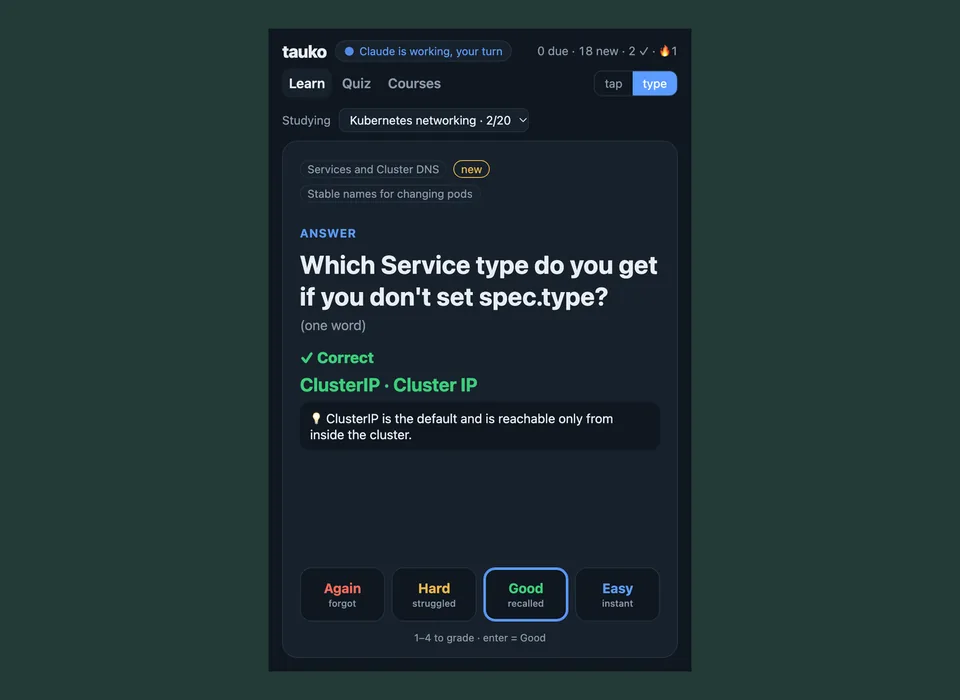
I built a small tool for this and called it tauko, which is Finnish for "a pause". When I press enter in Claude Code, a pane opens next to the chat with a flashcard in it. I type an answer, see what I missed, grade it, and maybe do another one. When Claude finishes, the pane says "Claude is done" and I go back to work.
One card takes 5 to 20 seconds. If Claude finishes in the middle of a card, I just leave it there. The card comes back later.
The answer check is forgiving in the right places. It ignores capital letters and punctuation, and a missing accent or a single typo counts as "almost" instead of wrong. That matters for languages. In Spanish, cene instead of cené is close, but it is also a different word, so tauko tells me exactly that.
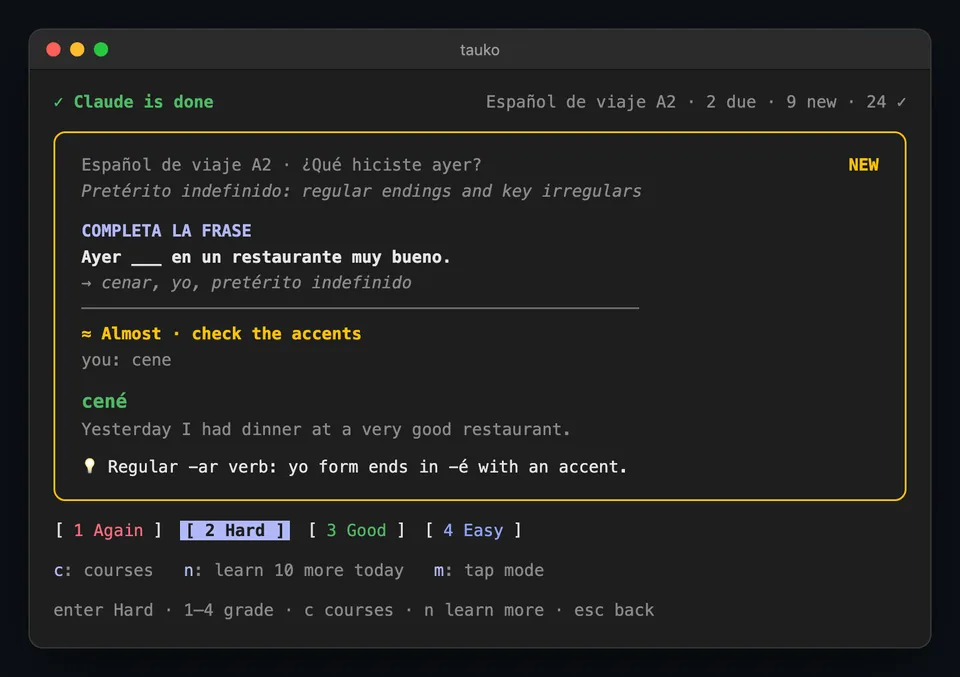
After each answer I grade the card from "Again" to "Easy". The grade decides when I see the card next.
Why flashcards, and why spaced#
Two ideas from learning research do most of the work here, and neither is new.
The first is that remembering something is better practice than reading it. Rereading notes feels productive because the material looks familiar. Trying to recall the answer, and sometimes failing, is what makes it stick. This is why tauko asks me to type the answer, or at least recall it before revealing it, instead of showing me a list to read.
The second is spacing. If I review something just before I would forget it, I remember it for longer each time. Hermann Ebbinghaus described forgetting curves in the 1880s, and spaced repetition has been studied ever since. tauko uses FSRS, a modern scheduler, to decide when each card comes back. This is what it does with a card I answer "Good" every time:
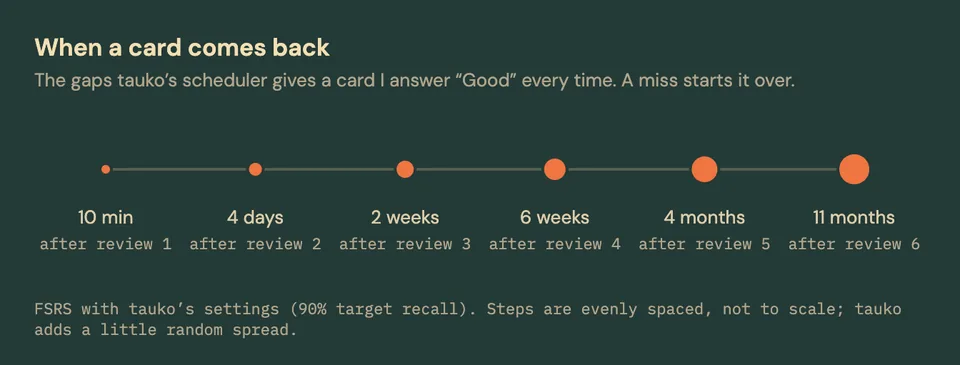
A new card comes back in ten minutes, then after four days, then two weeks. By the sixth review it's almost a year away. If I miss it, it starts over with short gaps. The result is that most of my cards are ones I'm close to forgetting, which is exactly where practice is worth the most.
This is also why the short waits are enough. Spaced repetition doesn't need long sessions. It needs many small ones, every day, and I already had about eighty of those.
Learning, not only testing#
The first version of tauko only had flashcards, and I noticed a problem quickly. Flashcards are good at keeping what I've already met, but they're bad at introducing new ideas. A card asking for a Finnish comparative is useless if I've never seen how comparatives are formed.
So a course can now start each idea with a short lesson. A lesson is 40 to 80 words, with one example, and takes less than 40 seconds to read. This one is from the Finnish course I'm studying:
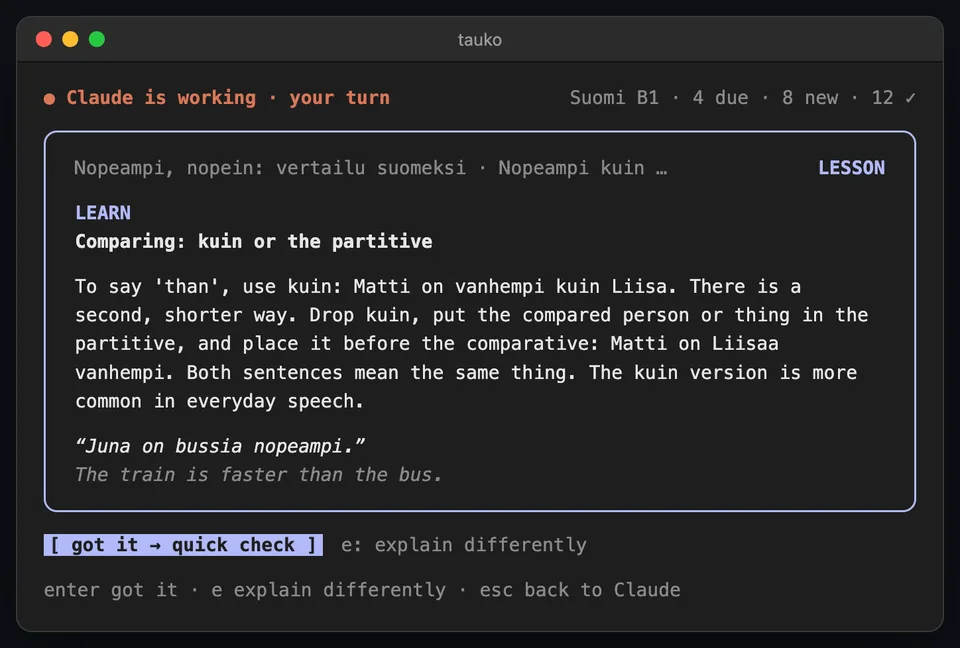
After the lesson comes a quick check, a card that anyone who just read it can answer. Then the spaced cards take over. Read once, check once, then keep.
The other thing I missed was asking "why?". When I get a card wrong, the right answer alone doesn't always explain what I did wrong. Pressing e after any card asks Claude to explain the answer I actually gave:
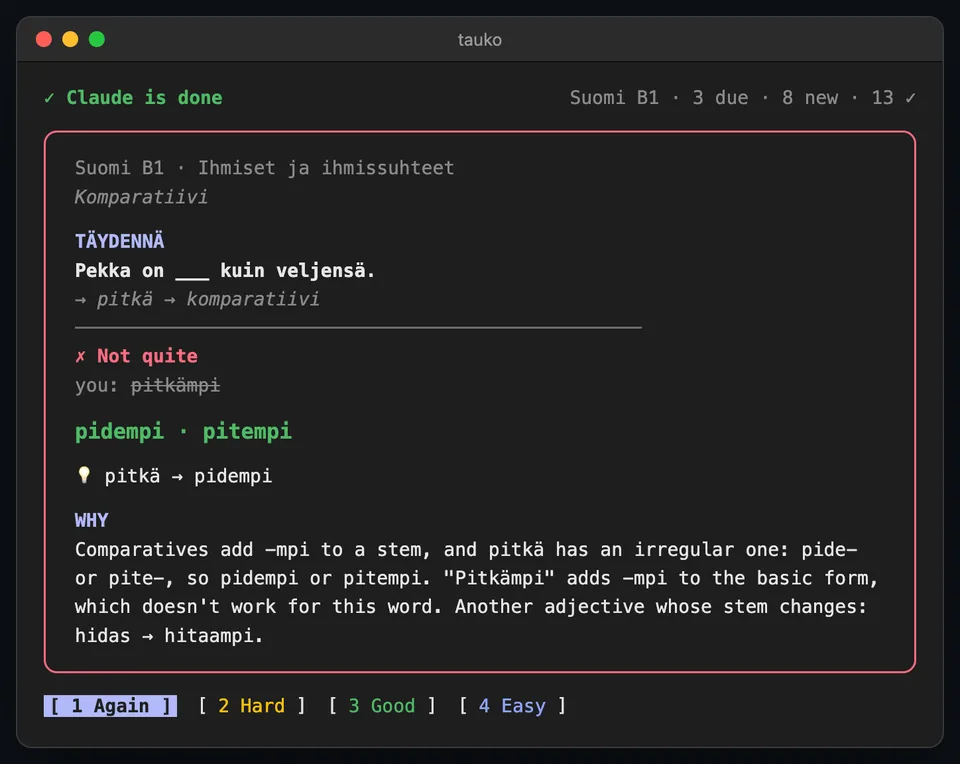
The explanation is about my mistake, not a general grammar lesson. It takes a few seconds and is saved, so asking again is instant. If I already know a card well, k retires it so it never comes back.
A course about anything#
I started tauko for Finnish, but nothing in it is about Finnish. A course is a folder of JSON files, and I can write one by hand. Usually I ask Claude to write it instead:
tauko gen "Spanish for travellers" -level A2
Claude drafts the lessons and the cards. Then a second, independent pass reviews every card as an expert would: is the answer right, are other correct answers missing, could the question be read two ways? It fixes what it can and removes what it can't. Finally, tauko checks the result itself before installing it.
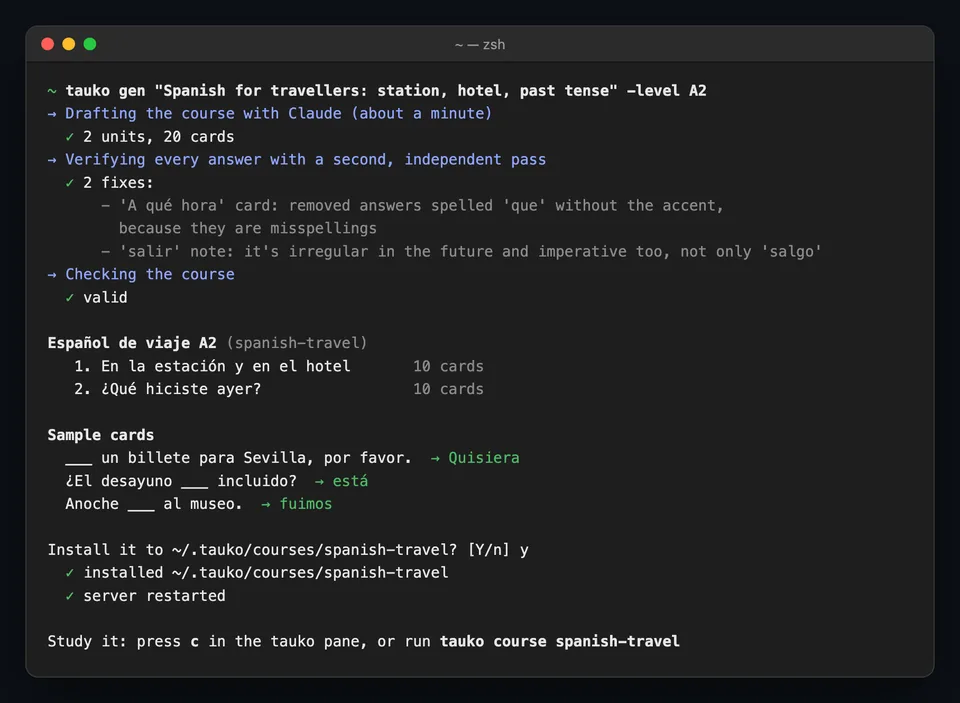
In the example above, the review fixed two cards. One accepted que without an accent as a correct spelling, and one note said a verb was irregular in only one tense when it's irregular in more. Those are the kinds of mistakes it's good at catching.
I don't trust the result completely, and I don't think anyone should. Generated courses are drafts. The review pass catches a lot, but a wrong or awkward card still gets through sometimes, and I fix it by editing the file. Still, a reasonable course on almost any topic in a minute changes what is worth learning in these gaps. A certification, the history of a place I'm about to visit, the terms in a new codebase.
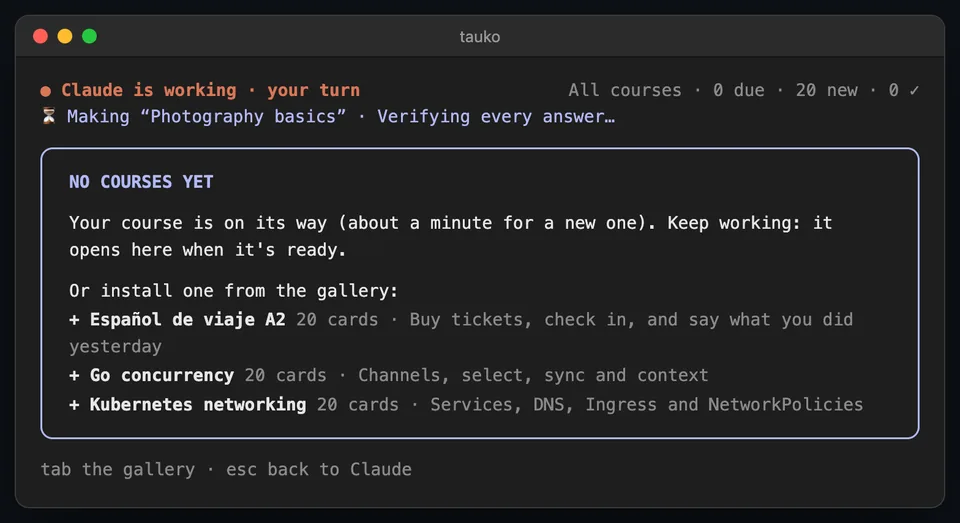
Since the latest version I can also do this without leaving Claude Code. I type a topic in the pane, keep working, and the course opens in the pane about a minute later. With no courses installed, the pane starts on this screen:
How it fits around Claude Code#
tauko is one Go program. When it runs, it starts a small server on my laptop that holds the cards, the schedule, and a SQLite database. Everything else talks to that server.
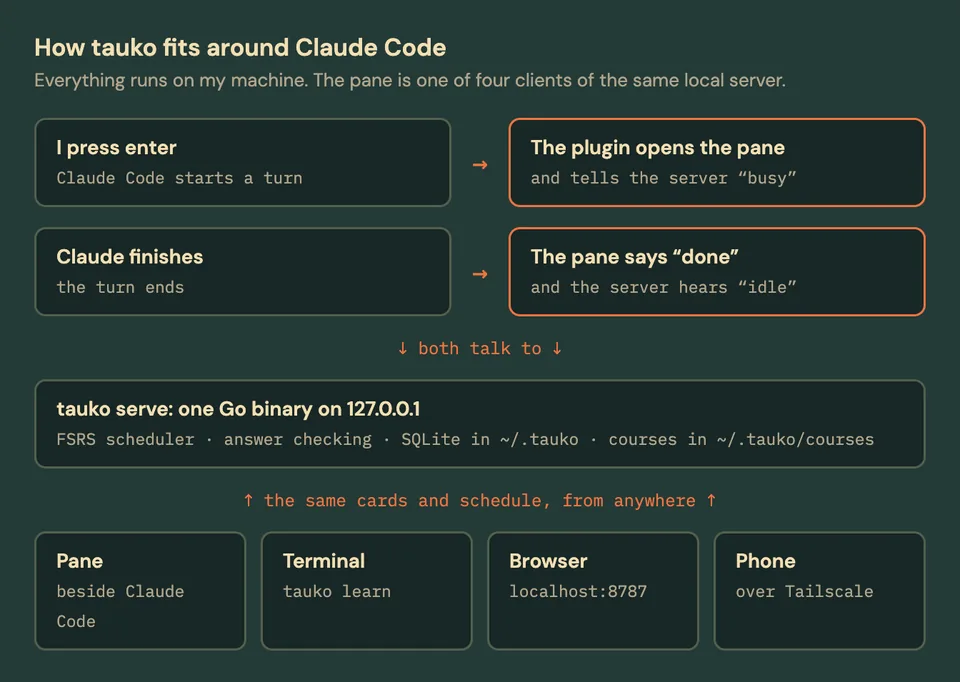
The pane is a Claude Code plugin. It listens for two moments: when I send a prompt, and when Claude finishes the turn. Everything else is the same server, so the terminal version, a browser tab, and my phone all see the same cards and the same schedule.
My progress stays in a folder in my home directory. There is no account and no telemetry. tauko only goes online to download a course from the public gallery, and to call Claude when I generate a course or ask for an explanation.
Building it with Claude#
There is an obvious irony in this project: I built a tool for the time I spend waiting for Claude, mostly by waiting for Claude.
It also showed me the problem clearly. While Claude was writing tauko, I was answering Finnish cards in the pane next to it. When it worked, it felt like a fair trade: Claude wrote code, and I learned something. The time didn't disappear into a feed.
The project grew in small steps. It started as a Finnish course and a terminal client. Then I ran out of cards in the middle of the day, so I added a practice mode that reviews whatever I'm closest to forgetting. Then I moved the Finnish course out of the program, so tauko could be about any subject. Then came course generation, lessons, explanations, and creating courses from the pane.
Not everything went smoothly. Today, while releasing the latest version, I found that upgrading tauko left the old server running in the background. The new pane talked to the old server and couldn't find the new features. The fix was small, but I only found it because I upgraded my own machine like a user would. I still have to do that part myself.
Is this a contradiction?#
In the essay I said I want to rely on my own intelligence first, and here I am using AI to write my study material. I've thought about that.
The difference, for me, is where the thinking happens. Claude writes the cards, but I'm the one who has to remember the answer. Nothing on the card is done for me. Recall is the part that can't be outsourced, and it's exactly the part a flashcard asks for.
The waiting also stays. I can't make Claude faster. What I can choose is whether those minutes make me a spectator or leave something behind.
What I've noticed so far#
The best part is that I don't have to decide to study. The prompt is the reminder, so the cards happen whether or not I'm in the mood.
It's also more honest than reading. I notice right away what I don't know, especially small things like a missing accent or a changed stem, which turn one word into another.
It doesn't replace real study. The gaps are good for keeping words and rules I've already met, and the short lessons help with new ideas, but a long conversation in Finnish is still a long conversation in Finnish.
And it doesn't fix everything about the waiting. Some waits are better spent doing nothing, or looking out of the window, or thinking about the problem Claude is working on. tauko is a better default than the phone, not a rule that every second must be productive.
What's next#
There are a few things I want to try next:
- Matching the material to the wait. A lesson when Claude is working on something long, a quick review when it isn't.
- Quizzes about the code Claude just changed. If an agent writes most of the code, I want to stay able to read it, so questions about the changes might help.
- A key for "my answer was right", which adds my answer to the card when the check is too strict.
- Imports from Anki and CSV, so existing decks work too.
Try it#
tauko is free and open source, and it runs on macOS and Linux:
curl -fsSL https://raw.githubusercontent.com/ralihachev/tauko/main/install.sh | sh
Then start Claude Code and send any prompt. If you have no courses yet, the pane will offer to make one. More details are on the project page and on GitHub.
If you try it, I'd like to hear what you study with it and what gets in the way. And if it gives you back some of those two hours, you can buy me a coffee.